
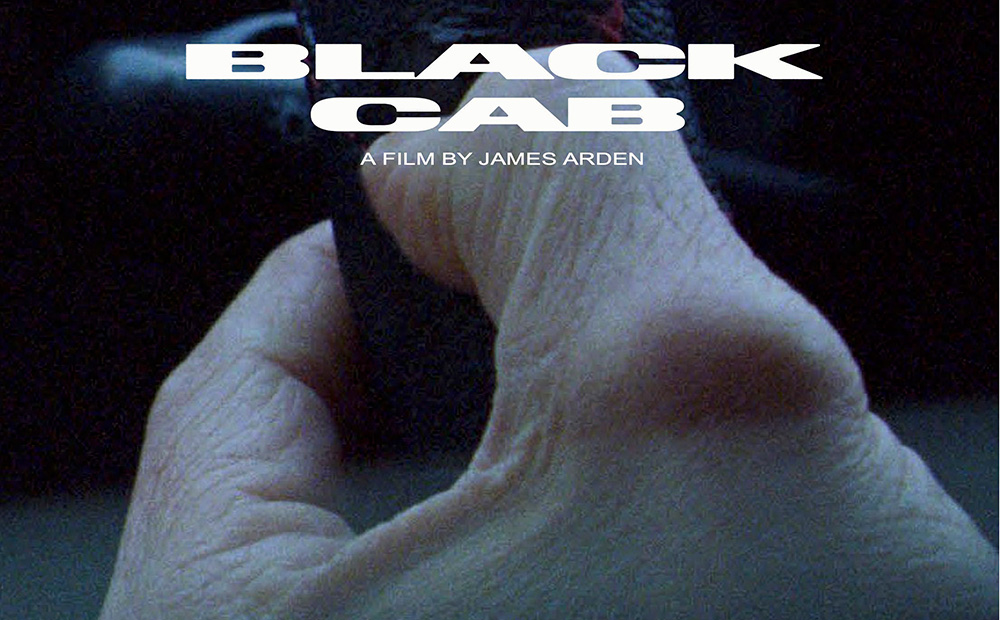

There is something especially unsettling about a science-fiction movie that barely feels like science fiction. Filmmaker James Arden’s 15-minute brute takes place in the near future. Some might say the very near is here.
Autonomous vehicles are here. Artificial intelligence is here. Automation is here. And for Harry, a third-generation London black-cab driver, the question isn’t whether technological change will arrive. It has arrived. Is there place for Harry? That makes BLACK CAB considerably more interesting than another cautionary tale about machines taking people’s jobs. Arden has made a film about encompassing dignity, masculinity, family, identity and the psychological consequences of becoming economically obsolete while we’re still perfectly capable of working.
A Cabbie Facing a Future That Doesn’t Need Him
Harry, played by Jay Simpson, belongs to a profession that is more than an occupation. London’s black cabs are cultural institutions, and the cabbies are part of that tradition. Harry is third-generation. Driving isn’t merely for him to earn money. It is something inherited. It connects him with family, history, London and his conception of himself. His place in the world.
Then comes a competitor that doesn’t need a driver. The setting is early 2027 when a fictional autonomous-car company, Ridar, has won the right to roll out self-driving vehicles. Arden developed the screenplay after more than two years of research that included interviewing actual cab drivers.
That research matters because BLACK CAB doesn’t treat Harry as an abstraction in an argument about artificial intelligence. He’s human. And that’s where the movie gets its power.
The Real Threat Isn’t the Car

Actor Jay Simpson as the doomed cabbie.
It would have been easy to turn BLACK CAB into an anti-technology polemic. Arden resisted that temptation. The driverless vehicles aren’t evil. There isn’t a sinister computer plotting Harry’s destruction. Technology is simply doing what technological innovation has always done: Making something faster, cheaper, easier or more efficient — while potentially making many somebodies unnecessary.
The unsettling question BLACK CAB raises is one our political and technological debates frequently avoid: What happens to the unnecessary people? We are hearing shrill, ominous, voluminous about what artificial intelligence and automation can do. We hear considerably less about what happens to the people whose livelihoods they can do without.
Truck drivers. Delivery workers. Taxi drivers. Writers. Actors. Journalists. Photographers. Office workers. And who knows how many professions next? It’s been reported that Filmmaker Arden said that he recognized a parallel between Harry’s anxiety and what people in creative industries are experiencing because of AI: Will their jobs exist five or 10 years from now?
That connection transforms BLACK CAB from a story about London taxi drivers into something considerably larger.
Jay Simpson Makes the Movie Work

For this film to succeed, we have to believe Harry. This reviewer-writer does. Simpson — whose film portfolio includes BLACK MIRROR, PISTOL and CHERNOBYL — doesn’t play Harry as some technologically bewildered bellicose character raging against progress. His performance is more complicated than. Harry is trying to hold onto his livelihood and, with it, his understanding of whom he is. That distinction is crucial. Losing a job can mean losing income. Losing a vocation can mean losing identity. BLACK CAB articulates the difference.
The supporting cast includes Gemma Dyllen as Harry’s wife, Emma, along with Anna-Maria Everett and Frankie Wilson. The domestic dimension prevents the movie from becoming an intellectual exercise about technological displacement. Harry’s crisis doesn’t remain inside his taxi. Economic anxiety follows workers home.
It invades marriages. It invades families. Envades bedrooms and kitchens. It changes how people regard themselves and one another.
Shot on Film!
There is also a wonderful contradiction in the way BLACK CAB was made: A movie about menacing technological obsolescence shot on 35mm film. Whoa!!!
Cinematographer Adam Barnett and Arden use the format to create a tactile, physical world surrounding a man confronting an increasingly automated one. The production used 35mm 2-perf, and Barnett has described employing long zooms and a cumbersome camera to reinforce Harry’s mounting dread and frustration.
Whether viewers consciously recognize the technical choices doesn’t particularly matter. They can feel them. There is weight to Harry’s world. And that’s appropriate because Harry himself is becoming trapped between two worlds: the physical, human, inherited world represented by the black cab and the frictionless technological future represented by automation. One requires knowledge, experience and a human being. The other doesn’t.
Fifteen Minutes, One Enormous Question
The advantage of the short-film form is ruthless concentration. The disadvantage is that 15 minutes doesn’t provide much room for philosophical wandering. Arden largely turns that limitation into an asset.Instead of attempting to explain the entire AI revolution, BLACK CAB reduces the issue to one worker.
One family. One livelihood. One man’s fear. That makes the technological argument personal. And perhaps that’s exactly how this debate needs to be conducted. Statistics can tell us how many jobs automation might eliminate or create. Economists can debate productivity. Technology executives can explain the extraordinary things their systems will accomplish. But none of those calculations completely answers Harry’s question:
Who am I if the world no longer needs what I spent my life learning how to do? That may become one of the defining questions of the AI era.
Is This Film Really a Movie Just About Taxi Drivers?
BLACK CAB premiered at the 2026 HollyShorts Film Festival and has selected for other qualifying festivals; it also received recognition at Britain’s Creative Circle Awards and the 1.4 Awards. Noteworthy awards. Arden’s movie recognizes a potentially enormous human cost buried beneath the excitement about technological progress. The argument over artificial intelligence is frequently presented as a contest between people who embrace innovation and people who fear it. BLACK CAB suggests that’s much too simple.
A person can understand progress and still fear being destroyed by it. A society can benefit from innovation while particular human beings pay an extraordinary price. And technological advancement doesn’t automatically answer the moral question of what society owes the workers it makes obsolete. That’s one of the live-wire nerves Arden touches. Harry isn’t necessarily fighting the future. He’s fighting to have a future inside it. And that makes BLACK CAB, despite its brief running time, a remarkably timely film.
————
TheWORDReview Verdict: BLACK CAB is a compact, visually assured and unsettling piece of social realism. Arden uses the threatened livelihood of one Londoner cabbie to pose a question considerably bigger than autonomous automobiles: When technology can replace what people do, what responsibility do we have to the people themselves? Is this a must-see film. Absolutely.

————
For additional background info check out Arden’s official page: James Arden – Writer/Director) James Arden — BLACK CAB official film page